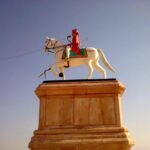

The Somnath Temple, on the shore of the Arabian Sea at Prabhas Patan in Gujarat, is revered as the first of the twelve jyotirlingas of Lord Shiva. Its history is one of repeated destruction and rebuilding. The present temple was built in the Chalukya style and consecrated in 1951 after India’s independence, with Sardar Vallabhbhai Patel closely associated with the effort.
This post gives a careful, balanced account of the temple’s history, noting where sources differ, and adds practical tips for visitors.
Quick facts
| Detail | Information |
|---|---|
| Location | Prabhas Patan, near Veraval, Gujarat |
| Deity | Lord Shiva (first among the 12 jyotirlingas) |
| Present temple | Rebuilt and consecrated in 1951 |
| Style | Chalukya (Kailash Mahameru Prasad) style |
| Famous association | Sardar Vallabhbhai Patel and the post-Independence restoration |
| Setting | Overlooks the Arabian Sea |
Why Somnath matters
For Hindus, Somnath is one of the holiest shrines, listed first in the traditional list of twelve jyotirlingas. The name is usually explained as ‘Lord of the Moon’ (Soma-natha). A well-known legend says the Moon god Soma worshipped Shiva here to be freed from a curse and regained his radiance. This is traditional belief rather than historical record, but it explains the temple’s deep spiritual appeal.
The place, also called Prabhas Patan, is also linked in tradition with the end of Krishna’s earthly life, and the nearby Triveni sangam is a sacred bathing spot.
Early temples
Historians connect the temple with the early medieval period, and one historian quoted in a news report relates it to the Chalukya era, while ancient texts, including the Mahabharata, mention the region. Traditional accounts describe earlier temples in gold, silver, and wood, built by different rulers. These stories belong largely to tradition, and there are limited archaeological records for the earliest phases, so it is safest to say that an ancient shrine stood here and that the site was later rebuilt several times.
Mahmud of Ghazni’s raid (11th century)
The best-documented early attack came in the winter of 1025-26 CE, when Mahmud of Ghazni raided the temple. The date is given as 1025 in some books and 1026 in others, so you will see both. A recent article quotes a historian saying Mahmud launched many raids into India, and that the attack on Somnath, in which wealth was looted and the linga damaged, was historically significant. King Bhima of Gujarat is described as having tried to stop the attack.
Accounts of the numbers killed and the wealth taken vary widely between sources, and some medieval writers exaggerated, so we do not quote specific figures. What most historians agree on is that the raid was a major shock that became part of the memory of the region.
Rebuilding and later attacks
After the raid, the temple was rebuilt by local rulers. Gujarat’s Chaulukya (Solanki) king Bhima and later rulers, such as Kumarapala, are credited in various accounts with reconstruction efforts. Later medieval sources mention further damage during the Delhi Sultanate period, including the campaigns of Alauddin Khilji’s army in Gujarat around 1299. Over the centuries, the temple was repeatedly attacked, restored, and again damaged. The exact sequence and the details differ between historians, and some Mughal-era accounts also mention orders to demolish the temple. If you want precision, check academic histories and not only popular articles.
Ahilyabai Holkar’s temple (1783)
In the 18th century, the Maratha queen Ahilyabai Holkar of Indore built a new temple near the ruins of the old one in 1783, since worship at the original site was not possible. This smaller temple, sometimes called the Old Somnath Temple, can still be visited close to the main shrine.
Independence and the 1951 reconstruction
After India became independent in 1947, Sardar Vallabhbhai Patel, the first Home Minister, visited Junagadh and Somnath and resolved that the temple should be rebuilt. He was supported by K. M. Munshi, a minister in the government, who played an important role in the project. After Patel’s death in December 1950, Munshi continued to lead the effort.
The new temple was built in the Chalukya style (Kailash Mahameru Prasad), designed by the Sompura family of temple architects from Gujarat. The jyotirlinga was ceremonially installed in May 1951 in a function presided over by the then President of India, Dr Rajendra Prasad. Our consulted news source says simply that Patel restored the temple in 1951, so check an official trust page for the exact day and details.
Rebuilding a temple with state involvement was debated at the time. Some leaders raised questions about the government’s role in a religious project. Those debates are part of the temple’s modern history as well.
Architecture of the present temple
The present temple is made of sandstone and has a shikhara (spire) and a tall flagpost on top. It faces the sea, and a famous pillar called the Baan Stambh (Arrow Pillar) stands nearby on the shoreline. An inscription on it is often described as stating that there is no land in a straight line between that point and the South Pole. This claim is widely repeated, but verify it carefully before quoting it as fact.
Visiting Somnath: practical tips
The temple is managed by the Shree Somnath Trust. Darshan timings, aarti schedules, and the evening sound-and-light show can change, and security rules apply, so please check the official Somnath Trust website for current information. We could not verify any timings or fees and have not quoted them. Last checked October 2026.
- Mobile phones, cameras, and large bags are generally not allowed inside, and lockers are provided. Rules change, so confirm on arrival.
- Arrive early to avoid long queues, especially during Maha Shivaratri, Kartik Purnima, and the month of Shravan.
- The seaside walk is pleasant in the evening. Dress modestly for the temple.
- Nearby places include the Triveni Sangam, Bhalka Tirth, and the Junagadh and Gir areas for those who plan a longer Saurashtra trip.
- Veraval is the nearest railway station, and there are airports in Diu and Rajkot, among others. Check current flight options.
Reading the history with care
Somnath is a topic where popular articles, temple trust pages, and academic histories sometimes tell the story differently. A good habit is to separate three layers: what religious tradition says about the temple’s origin, what inscriptions and chronicles record about specific attacks and rebuilds, and what government and trust records document about the modern reconstruction. When you read a number or a date, ask which layer it comes from. This approach keeps your understanding balanced and respectful, and it helps you spot exaggeration when you meet it online or from guides.
Conclusion
The Somnath Temple stands as a symbol of resilience for many devotees, and a subject of debate for historians. Whatever your perspective, understanding the layered history helps you see the temple as more than a monument: it is a place where faith, memory, and politics meet. Visit with respect and rely on official sources for current rules.
Frequently Asked Questions (FAQ)
Why is Somnath Temple famous?
It is revered as the first of the twelve jyotirlingas of Lord Shiva and is known for being rebuilt many times after attacks.
Who rebuilt Somnath Temple after Independence?
Sardar Vallabhbhai Patel initiated the restoration, with K. M. Munshi leading it after Patel’s death. The temple was consecrated in 1951.
When did Mahmud of Ghazni attack Somnath?
The raid is dated to around 1025-26 CE. Books give either 1025 or 1026.
Who built the Old Somnath Temple near the main shrine?
Ahilyabai Holkar of Indore built it in 1783.
What style is the present Somnath Temple?
It is built in the Chalukya style, known as Kailash Mahameru Prasad.