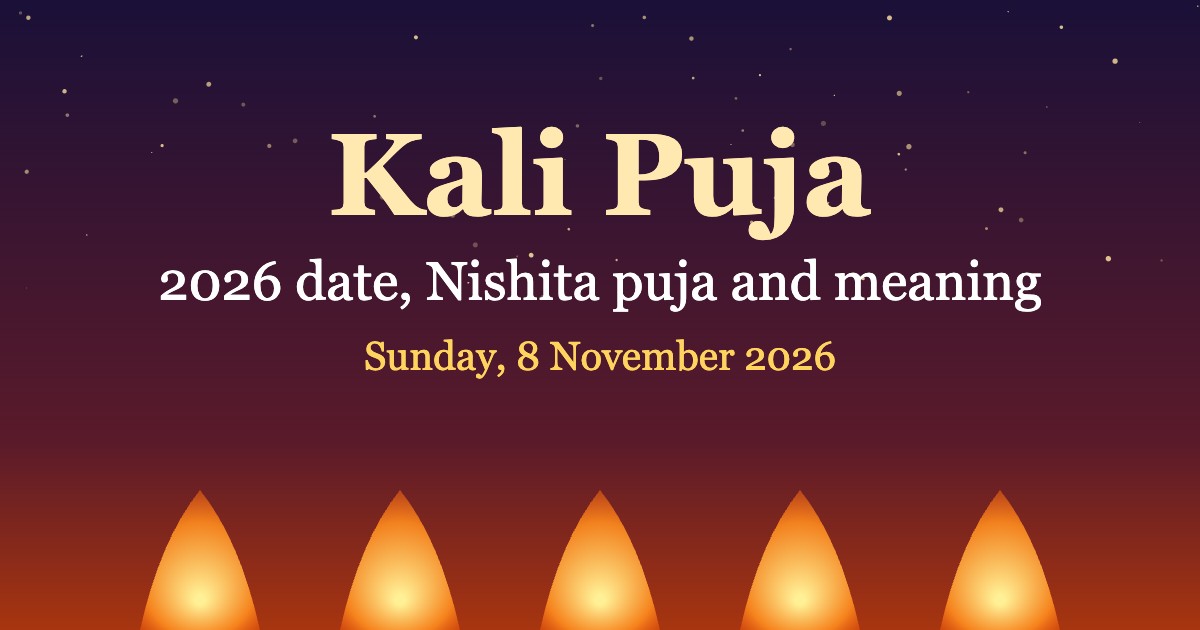
Kali Puja is the night of worship of Goddess Kali, held on the new-moon night of the month of Kartik, the same night that most of India celebrates Diwali. It is especially big in West Bengal, Assam, Odisha and the Bengali community abroad. Pandals, midnight rituals, lamps and fireworks mark the night. This guide explains the 2026 date, the midnight puja time, the meaning of the festival and how it differs from Diwali.
Kali Puja 2026 date and timing
In 2026, Kali Puja falls on Sunday, 8 November, the same day as Diwali. The amavasya (new-moon) tithi begins in the late morning of 8 November (about 11:27 AM IST by one calendar, with others showing a slightly different time) and runs into 9 November. The main worship is done at night during Nishita Kaal, the middle of the night, which one source lists as roughly 11:39 PM to 12:31 AM on the night of 8–9 November. Timings differ by city and calendar, so please check a local panchang or your pandal’s schedule.
Who is Goddess Kali?
Kali is a fierce form of the Goddess, associated in tradition with the destruction of evil, the removal of ego and fear, and protection. Devotees see her both as a fearsome warrior and as a loving mother. The festival is a night of devotion, discipline and community.
Kali Puja vs Diwali: what is the difference?
Across much of North India, the new-moon night of Kartik is Lakshmi Puja, when homes are lit with diyas and Lakshmi and Ganesha are worshipped. In Bengal, Assam and Odisha, the same night is Kali Puja, and the goddess worshipped is Kali. Many Bengali homes also light lamps and burst crackers, so it feels like a Diwali night as well. Both celebrate the victory of light over darkness.
How the night is celebrated
- Pandals and idols: public pandals, often large and artistic, in cities such as Kolkata and Guwahati, with idols of Kali installed days before.
- Home puja: families worship at home with flowers, lamps, sweets and fruits, often through the night.
- Nishita puja: the main ritual around midnight, with mantras and offerings.
- Offerings: flowers (especially red hibiscus), sweets, rice, lentils and, in some communities, other traditional offerings that vary by region and family.
- Chaturdashi lamps: the day before, Bhoot Chaturdashi, Bengali families light fourteen lamps and eat fourteen kinds of greens in the Bengali tradition.
- Lights and crackers: use caution and follow local rules, especially about air quality and noise.
History in brief
The tradition of worshipping Kali on the Diwali night in Bengal is often linked to the 18th-century period of Raja Krishnachandra of Nadia, who is said to have popularised it. Over time it grew into one of Bengal’s biggest festivals, second only to Durga Puja in many places. Sources differ on the early history, so treat this as a traditional account.
If you live abroad
- Check your local Bengali association (Pujo committee) for a Kali Puja event.
- If you celebrate at home, a simple puja with a picture of Kali, a lamp and flowers is enough for many families.
- Check local rules about fireworks and candles, especially in apartments.
Frequently asked questions
When is Kali Puja in 2026?
Sunday, 8 November 2026, with the main puja at night.
Is Kali Puja the same day as Diwali?
Yes, in 2026 and in most years. It is celebrated on the new-moon night of Kartik, which is also the Diwali night in much of India.
Do you need a priest to do the puja?
Public pandals have priests. At home, many families do a simple puja themselves or call a local priest. Follow your family tradition.
Related reading: Diwali, the festival of lights, Durga Puja explained, and in Hindi नरक चतुर्दशी.
Religious beliefs and customs described here are traditional and vary by region and family. Dates and timings are provisional.