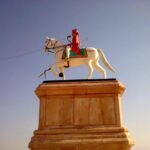

Hampi, in Karnataka, was the capital of the Vijayanagara Empire, one of the greatest Hindu empires of South India. Founded in 1336, the city was destroyed after the Battle of Talikota in 1565 and left in ruins. Its temples, palaces and boulder-strewn landscape are now a UNESCO World Heritage Site (inscribed 1986).
Quick facts
| Detail | Information |
|---|---|
| Place | Hampi, Vijayanagara district, Karnataka (on the Tungabhadra river) |
| Empire founded | 1336 |
| Golden age | Early 16th century, under Krishnadevaraya |
| Fall of the city | After the Battle of Talikota, 1565 |
| UNESCO | World Heritage Site since 1986 |
| Area | About 4,187 hectares in the core protected zone |
| Nearest rail/air | Hosapete railway station (about 13 km); Hubballi and Ballari airports are the usual options |
Origins of Vijayanagara
The Vijayanagara Empire rose in 1336 under brothers Harihara I and Bukka I, in a time when the Deccan faced pressure from the Delhi Sultanate. They chose the dramatic landscape along the Tungabhadra as their capital, a site with natural rock defences. The region was already sacred: Hampi’s old name, Pampa, comes from a local goddess, and the area has long been linked with the Kishkindha episodes of the Ramayana.
The golden age under Krishnadevaraya
The empire reached its peak in the early 1500s under Krishnadevaraya of the Tuluva dynasty. Travellers from Portugal and Persia described a rich, busy city with markets selling jewels and cloth. The city had grand temples, water tanks, aqueducts and royal buildings. Krishnadevaraya himself was a patron of art, music and Telugu literature, and he expanded the Virupaksha temple complex.
Defeat at Talikota and the fall of Hampi
In 1565 a coalition of the Deccan sultanates defeated the Vijayanagara army in the Battle of Talikota. The victors then plundered the capital, and it was reportedly burned and looted for months. The rulers shifted their base elsewhere, and Hampi was never again a living imperial city. Over time it became a ruin and local pilgrimage site.
Must-see monuments
- Virupaksha Temple: the oldest and still-active temple, with a tall gopuram about 50 metres high. Pilgrims have worshipped here continuously.
- Vittala Temple and Stone Chariot: the most famous image of Hampi, with intricate pillars. The nearby hall has pillars that make musical notes when tapped, though visitors are now asked not to touch them.
- Hemakuta Hill: a hill with many small early temples and a good sunset view.
- Lotus Mahal: a two-storey pavilion in the royal enclosure that blends Hindu and Indo-Islamic styles.
- Elephant Stables: eleven domed chambers once used for royal elephants.
- Hazara Rama Temple: carved panels telling the story of the Ramayana.
- Queen’s Bath and Mahanavami Dibba: the royal enclosure’s bathing pavilion and a large ceremonial platform.
The landscape
Hampi’s huge boulders, banana fields and river make it unlike other heritage sites. Many visitors climb Matanga Hill at sunrise, take a coracle ride on the river, or cycle among the ruins. The site is spread over many kilometres, so you need more than a day to see it properly.
Planning your visit
- Best time: October to February, when the weather is cooler. Summer is very hot.
- How many days: two days is a good minimum; three if you want to explore slowly.
- Getting around: rent a bicycle, scooter or hire an auto or e-vehicle. Walking between all sites is tiring.
- Tickets and timings: major paid monuments such as the Vittala Temple and the royal enclosure are run by the ASI and have fixed timings and fees. Please check the official ASI and Karnataka Tourism sites before you go (last checked October 2026; we could not verify current prices or hours).
- Stay: stay options are on both sides of the river, in Hampi village and in Virupapur Gaddi. Rules about guesthouses on the Hampi side have changed in the past, so confirm in advance.
A simple itinerary
| When | Where to go |
|---|---|
| Day 1 morning | Virupaksha Temple, Hampi Bazaar, Hemakuta Hill |
| Day 1 evening | Sunset from Matanga Hill or Hemakuta Hill |
| Day 2 morning | Vittala Temple, stone chariot, Tungabhadra riverbank |
| Day 2 afternoon | Royal enclosure: Lotus Mahal, Elephant Stables, Queen’s Bath, Mahanavami Dibba |
| Optional | Anegundi side, Hanuman temple on Anjanadri Hill, coracle ride |
This is a suggestion, not an official route. Opening hours and entry rules for ASI-run monuments can change, so check ahead.
Reading the ruins: Hindu and Indo-Islamic styles
Hampi is interesting because it did not belong to just one tradition. Temples follow the Dravidian style, with tall gopurams and pillared halls with carved animals and mythical creatures. Yet buildings in the royal centre, such as the Lotus Mahal and the Elephant Stables, show domes and arches that reflect influence from the neighbouring Deccan sultanates. This mix is a good reminder that Vijayanagara was a cosmopolitan empire which traded widely and employed artists from many backgrounds.
The city also had an advanced water system, with stone aqueducts, channels and step tanks like the Pushkarini. Walking by these gives a sense of how large and well-organised the capital was.
What to remember for exams
- Harihara I and Bukka I founded the empire in 1336.
- Krishnadevaraya of the Tuluva dynasty was its greatest ruler.
- The Battle of Talikota (1565) ended the capital’s glory.
- Hampi is a UNESCO World Heritage Site (1986).
Conclusion
Hampi is where history feels alive: a capital that once rivalled any city in the world, now silent among rocks and temples. Go with time and curiosity, and it will give you one of the best heritage trips in India.
Frequently Asked Questions (FAQ)
Who founded the Vijayanagara Empire at Hampi?
Brothers Harihara I and Bukka I founded the empire in 1336.
Why was Hampi destroyed?
After the Battle of Talikota in 1565, the invading sultanate armies plundered and burned the capital.
What is Hampi famous for?
It is famous for the Vittala Temple stone chariot, Virupaksha Temple and its boulder landscape.
Is Hampi a UNESCO World Heritage Site?
Yes, it was inscribed in 1986.
What is the best time to visit Hampi?
October to February is usually the most comfortable period.